

Transitions During Change
In “Transitions: Making the Most of Change,” William Bridges observed: “Change is not the same as transition. Change is situational. Transition is the psychological process (emphasis added) people go through to come to terms with the new situation. The starting point for transition is not the outcome, but the ending that you will have to make to leave the old situation behind. Situational change hinges on the new thing, but psychological transition depends on letting go of the old reality and the old identity you had before the change took place.”
Change is the event; transition is the process you go through in response to that change. Seeking new careers, moving into a new home, children leaving for college, the death of a loved one are all examples of changes that uproot our day-to-day existence routine and comfort and into a life requiring many decisions and new patterns. This is the work of transition.
Bridges has identified three distinct periods in transition: Endings (shore), Neutral Zone (sea), New Beginnings (new shore) Every transition begins with an ending and ends with a beginning. In between the changes there are times when we do not know exactly what is occurring and what is expected from us. It is in that “neutral zone” (which we all mostly want to avoid) that the greatest personal growth takes place. Bridges observes “We resist transition not because we can’t accept the change but because we can’t accept letting go of that piece of ourselves we have to give up when and because the situation has changed.” The graphic below identifies some of the feelings that are present in these different periods. Notably, grief can show up in any of these places.
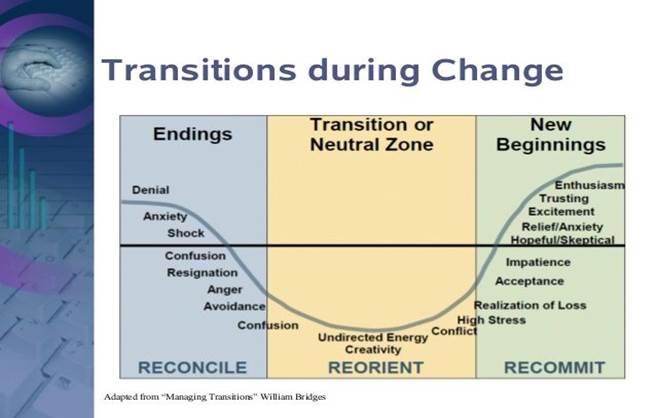
Asked about transitions, many people would identify the ending and new beginning, but most skip over the neutral zone. In the neutral zone, the old reality is gone, and the new sense of identity isn’t fully operational. People are in flux and may feel confusion and distress. Importantly, however, the neutral zone is the seedbed for new beginnings. New perspectives open the way for creativity and new possibilities.
In the neutral zone, uncertainty about what is next and challenges adopting to change can produce “marathon effect.” The marathon effect happens when different people affected by a change are at different stages – much like runners in a marathon. These runners might have an idea of what the marathon route looks like, but they don’t know how their race will unfold for them on that particular day, how they are going to feel during the race, or if the weather will hold. They also don’t necessarily know how the race is going for the lead runners, or even how far ahead the front runners actually are. Runners eventually get to the finish line, but they do so at different times. This is similar for any group affected by a change. People will move through transition, but at different paces. Communication, compassion, and listening to one another is key on this journey.
Blessings,
Nancy+
Questions to ponder:
- What are some transitions you have experienced in your life?
- Name some of the feelings, surprises and learnings.
- What helped you move through the “neutral zone’ time?
- What did you come to know about God?